GEOTECHNICALENGINEERING
NORTH BAY ONTARIO

Geotechnical Engineering in North Bay Ontario

Technical studies that support your project.

LEARN MORE

North Bay sits right where the Canadian Shield meets the Great Lakes lowlands, a geological transition that creates some of the most variable ground conditions in Ontario. The winters here are no joke either—frost can penetrate over 1.8 meters, and the freeze-thaw cycles chew through weak soils in ways that standard southern Ontario designs just don't account for. A soil mechanics study in this region has to capture the full picture: glacial till lenses that change stiffness every few meters, pockets of soft varved clay from the old glacial Lake Algonquin, and bedrock that can be either solid granite or heavily fractured gneiss within the span of a single borehole. For anyone developing along the Highway 11 corridor or densifying near the downtown core, skipping this level of characterization is asking for differential settlement problems that show up within the first two winters. We typically complement the field investigation with a grain-size analysis to quantify the fines content in those till layers, because the drainage behavior here swings wildly between well-graded sand and silty matrix material.

In North Bay, the difference between a foundation that performs for 50 years and one that cracks in five winters often comes down to whether the soil mechanics study identified the true bedrock contact and the sensitivity of the overlying clay.
Geotechnical Engineering in North Bay Ontario
Technical reference — North Bay Ontario

Our service areas

Local geology

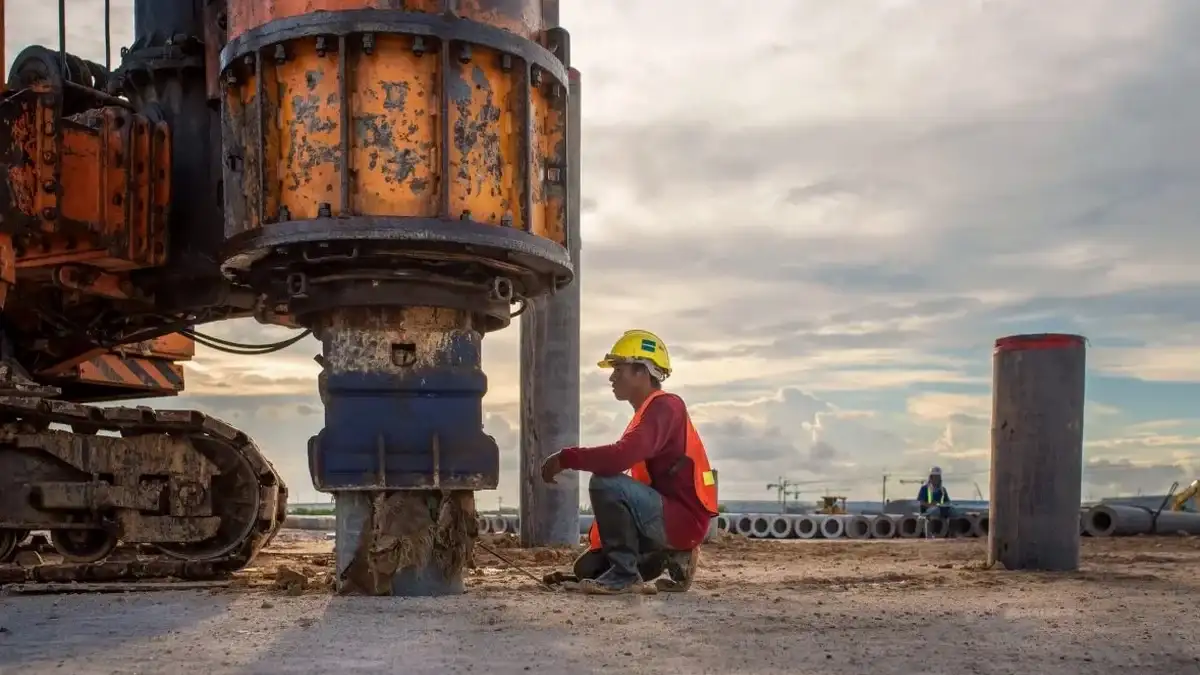
A project we worked on near Trout Lake involved a three-story mixed-use building where the initial boreholes hit competent rock at 3.5 meters on the east side but encountered 7 meters of soft silty clay on the west side. The developer had assumed uniform conditions based on a preliminary site walk—a common mistake in North Bay. The final soil mechanics study included consolidated undrained triaxial testing on the clay samples, which showed a sensitivity ratio above 4, meaning the material could lose significant strength if disturbed during excavation. We ended up recommending a transition from shallow footings to drilled shafts socketed into sound rock, with a grade beam to bridge the stiffness contrast. This scenario repeats itself across the city: the shield outcrops near Nipissing University are completely different from the lacustrine deposits down toward Callander. A thorough study has to include shear strength parameters under both drained and undrained conditions, consolidation characteristics for any compressible layers, and a clear identification of the groundwater regime, which in North Bay often sits perched on the till-rock interface and fluctuates seasonally.

Applicable standards

NBCC 2020 (National Building Code of Canada, Division B, Part 4), CSA A23.3:19 (Design of Concrete Structures, foundation provisions), ASTM D2487 (Unified Soil Classification System for lab classification), ASTM D4767 (Consolidated Undrained Triaxial Compression Test for Cohesive Soils), ASTM D1586 (Standard Penetration Test and Split-Barrel Sampling)

Need a geotechnical assessment?

Reply within 24h.

Email: info@geotechnicalengineering.xyz

Video overview

Why choose us

The NBCC 2020 seismic provisions apply in North Bay even though the region lies outside the high-seismicity zones of the St. Lawrence or the West Coast. The combination of soft clay over stiff till or rock creates a site class D scenario where the fundamental period of the soil column can amplify ground motion in ways that designers who only look at the peak ground acceleration miss entirely. Under CSA A23.3, foundations on sensitive clay require specific evaluation for post-peak strength loss, especially if the site falls within the groundwater fluctuation zone that saturates the upper soil profile each spring. The frost heave potential in North Bay is among the highest in Ontario because of the fine-grained matrix in the glacial till—ASTM D5918 testing shows heave rates that can exceed 15 mm per season if the footing base isn't placed below the maximum frost penetration depth. And in areas where the bedrock surface slopes more than 15 degrees, the risk of translational sliding along the soil-rock interface becomes a governing failure mode that only a detailed study can quantify.

Reference parameters

ParameterTypical value
Frost penetration depth (design)1.8 – 2.2 m per NBCC climatic data
Typical bedrock depth (downtown core)2.0 – 8.0 m, highly variable
Glacial till density19 – 23 kN/m³, stiff to very stiff
Sensitive clay shear strength (undisturbed)35 – 75 kPa (varved deposits)
Groundwater (perched on till/rock)1.0 – 4.5 m below grade, seasonal
Rock Quality Designation (RQD)25% – 85% (fractured to excellent)
Seismic site class (NBCC)C to D depending on overburden thickness

Quick answers

What does a soil mechanics study include for a site in North Bay?

The scope follows NBCC 2020 requirements and typically includes a desktop review of surficial geology maps (the Quaternary mapping for the Nipissing region shows extensive glacial till and lacustrine deposits), a borehole program with SPT sampling per ASTM D1586, laboratory index testing (grain size, Atterberg limits), and strength testing such as triaxial or direct shear. If the site is underlain by sensitive clay or the water table is perched, we add consolidation testing and chemical analysis for groundwater. The final report provides bearing capacity, settlement estimates, frost protection depth, and seismic site class.

How much does a soil mechanics study cost in North Bay?

For a typical residential or small commercial lot in North Bay, the study falls between CA$4,100 and CA$6,610. The final number depends on borehole depth (bedrock can be at 2 meters or 8 meters, which changes drilling time), the number of samples requiring lab testing, and whether specialized tests like triaxial or consolidation are needed. Sites with difficult access or known sensitive clay may push toward the upper end of that range.

How long does it take to complete a study and get the report?

Fieldwork in North Bay is seasonal—drilling in frozen ground is possible but slower, so winter projects add a day or two. Under normal conditions, the borehole program takes 1 to 2 days on site, lab testing runs 10 to 14 business days, and the interpretive report is delivered within 3 weeks total from mobilization. If the lab queue is light and the stratigraphy is straightforward, we've turned reports around in 12 days.

What makes North Bay soil conditions different from other Ontario cities?

The big difference is the transition zone between the Precambrian Shield and the Paleozoic lowlands. You get hard granite outcrops right next to deep clay basins, sometimes on the same lot. The glacial Lake Algonquin left varved clays that are sensitive—they lose strength if remolded, which isn't common in the dense tills of the GTA. Plus the frost depth here is among the deepest in southern Ontario because of the colder winter temperatures and the fine-grained soils that wick moisture. A study designed for Barrie or Toronto won't capture these conditions.

Location and service area

We serve projects in North Bay Ontario and surrounding areas.

View larger map