GEOTECHNICALENGINEERING
NORTH BAY ONTARIO
HomeLaboratoryLaboratory CBR test

Laboratory CBR Testing in North Bay Ontario: Accurate Subgrade Strength for Pavement Design

Technical studies that support your project.

LEARN MORE

Last spring, a contractor on McKeown Avenue had a problem: the new commercial parking lot showed rutting before the asphalt even cured. The subgrade was a silty sand from the Nipissing glacial deposits—looked firm during grading, but lost all strength once we got a wet October. Our lab ran a soaked CBR on the material and got values under 3%. That changed the entire pavement structure. Instead of 150 mm of granular A, the final design required 300 mm of granular B plus a geogrid. This is the reality of building in North Bay, where the ancient glacial lakebed sediments can fool even experienced operators. A standard Proctor and a grain size analysis are useful, but the laboratory CBR tells you how that compacted material will actually behave under traffic load, especially after the spring thaw saturates everything. We run both unsoaked and 96-hour soaked CBR tests in our accredited lab, giving designers the numbers they need to apply the AASHTO 1993 pavement design method or the mechanistic-empirical MEPDG approach with local confidence.

A soaked CBR value isn't just a number for the report—it's the difference between a pavement that survives 20 Ontario winters and one that fails in the first spring thaw.
Our service areas

Process and scope

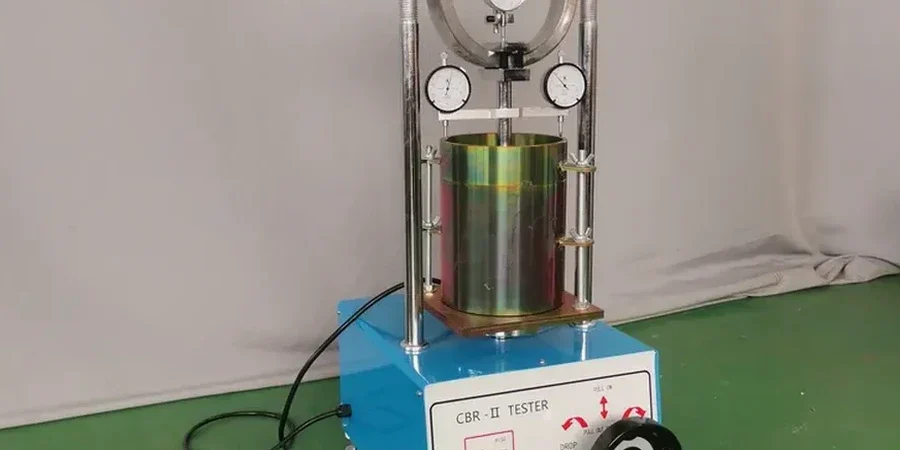
The Ontario Provincial Standard Specifications (OPSS) and the Ontario Building Code reference ASTM D1883 as the standard for laboratory CBR determination, and for good reason. North Bay's subgrade materials—predominantly glaciolacustrine silts and fine sands with occasional clay seams—are highly moisture-sensitive. A CBR test run at optimum moisture content might show 12%, but that same sample after 96 hours of soaking can drop to 2%. That's not a lab curiosity; it's what happens every April when the frost comes out of the ground. Our testing procedure follows ASTM D1883 exactly: we compact specimens at modified Proctor effort, apply a surcharge weight simulating the overlying pavement structure, and measure penetration resistance with a calibrated proving ring at 0.1 inches per minute. We've seen projects where combining the lab CBR with an in-situ CBR test on the compacted lift caught a 40% strength discrepancy caused by poor compaction technique. The lab test gives you the material's potential under ideal compaction; the field test confirms you achieved it. For granular base and subbase materials, we also run the CBR on specimens compacted in a 6-inch mold per ASTM D1883, with the oversized fraction corrected using the scalping and replacement method.
Laboratory CBR Testing in North Bay Ontario: Accurate Subgrade Strength for Pavement Design
Technical reference — North Bay Ontario

Site-specific factors

North Bay sits on the northern edge of the Nipissing Lowlands, where the post-glacial Lake Nipissing left behind thick sequences of varved silts and clays. These soils are notorious for frost heave and spring softening. We've measured CBR reductions of 60% to 80% between fall and spring conditions on the same subgrade material. The risk isn't just rutting—a CBR below 3% soaked means you cannot achieve the structural number required for a collector road without a full-depth granular replacement or chemical stabilization. The 2012 reconstruction of a section of Highway 11 north of North Bay dealt with exactly this: subgrade CBR values of 1.5% to 2% forced a 900 mm granular overlay. In urban infill projects around the city center, we often encounter old fill with brick fragments and ash that gives wildly variable CBR results—15% in one spot, 3% three meters away. That variability demands a tighter sampling grid. We also coordinate CBR testing with Atterberg limits to identify high-plasticity silts (MH soils) that will pump water into the granular base under repeated loading.

Need a geotechnical assessment?

Reply within 24h.

Email: info@geotechnicalengineering.xyz

Applicable standards

ASTM D1883-21: Standard Test Method for California Bearing Ratio (CBR) of Laboratory-Compacted Soils, ASTM D1557-12(2021): Standard Test Methods for Laboratory Compaction Characteristics of Soil Using Modified Effort, OPSS 1010: Material Specification for Aggregates – Base, Subbase, Select Subgrade, and Backfill Material, AASHTO Guide for Design of Pavement Structures (1993), with Ontario MTO regional calibration factors, ISO/IEC 17025:2017 – General requirements for the competence of testing and calibration laboratories (our lab accreditation standard)

Reference parameters

ParameterTypical value
StandardASTM D1883-21, OPSS 1010 reference
Mold Size6-inch (152.4 mm) diameter standard; 4-inch available for fine-grained soils
Compactive EffortModified Proctor (56,000 ft-lbf/ft³) per ASTM D1557
Soaking Period96 hours submerged with surcharge weights applied
Penetration Rate0.05 in/min (1.27 mm/min) for standard CBR; 0.10 in/min accepted
Swell MeasurementDial gauge reading daily during soak; swell vs. time reported
CorrectionsConcave upward correction applied when initial tangent does not pass through origin
Typical Soaked CBR Range (North Bay silts)2% to 8% for native subgrade; 30%+ for Granular A and B

Quick answers

How much does a laboratory CBR test cost in North Bay?

A single-point CBR test (one compaction point, one specimen) typically ranges from CA$160 to CA$290, depending on whether you need soaked or unsoaked conditions and how many swell readings we take. Most pavement designs require a three-point CBR curve (three different moisture contents) to establish the strength-moisture relationship, which brings the total closer to CA$480 to CA$870 for the full dataset. We always recommend the soaked test for Ontario subgrade materials—the unsoaked value alone can overestimate field strength by a factor of two or more.

How is the laboratory CBR different from a field CBR test?

The lab CBR (ASTM D1883) tests a remolded, compacted specimen under controlled moisture and density conditions—it tells you the material's potential strength when properly placed. The field CBR (ASTM D4429) measures the in-place strength of the compacted soil or aggregate at its current moisture content. In North Bay's silty subgrades, we often see field values 30% to 50% lower than lab values because of moisture changes during construction. We typically run both: the lab CBR for pavement design, and the field CBR for compaction quality control during construction.

How long does a soaked CBR test take from sample delivery to report?

The full procedure takes about seven to ten business days from the moment we receive the sample. The timeline breaks down as follows: moisture-density relationship (Proctor) takes two days including overnight moisture conditioning; specimen compaction and setup with swell measurement takes one day; the 96-hour soaking period takes four days; and the penetration test plus data reduction and reporting takes one to two additional days. If you need rush results, we can run the Proctor and CBR in parallel with expedited conditioning, cutting the total to about five working days.

Location and service area

We serve projects in North Bay Ontario and surrounding areas.

View larger map