GEOTECHNICALENGINEERING
NORTH BAY ONTARIO
HomeUnderground ExcavationsGeotechnical design of deep excavations

Deep Excavation Design in North Bay: Rock, Clay, and Groundwater Reality

Technical studies that support your project.

LEARN MORE

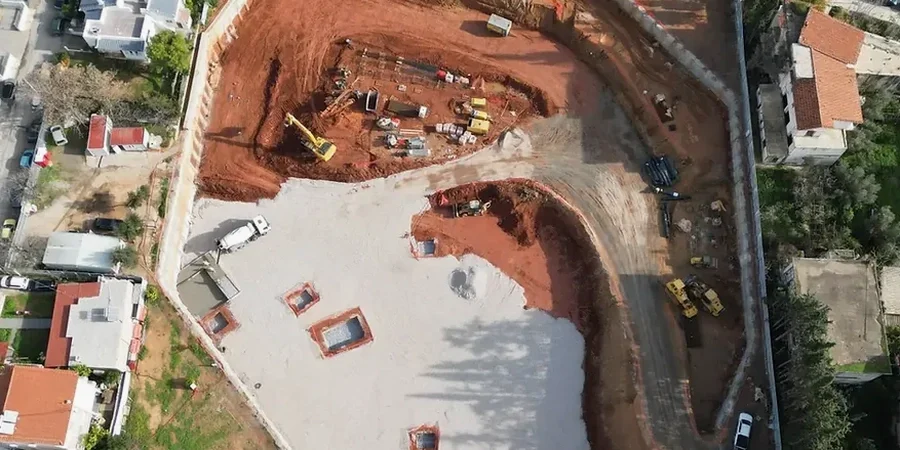
When you excavate more than four meters in North Bay, you stop dealing with dirt and start dealing with a legacy of glaciation. The soil profile here is rarely uniform: compact silty till draped over fractured Precambrian rock, with pockets of soft varved clay from ancient Lake Barlow-Ojibway. Our team has spent years interpreting these transitions because the difference between a stable cut and a collapse often comes down to reading what the last ice age left behind. A deep excavation near Trout Lake behaves nothing like one in the Ferris area, and that local nuance is what drives our deep-excavations approach from day one. Many projects also benefit from a preliminary cpt-test to map soft clay lenses before shoring design begins.

In North Bay, the most dangerous assumption is that bedrock is a uniform floor. Fracture networks and dipping contacts turn every deep dig into a three-dimensional groundwater puzzle.
Our service areas

Process and scope

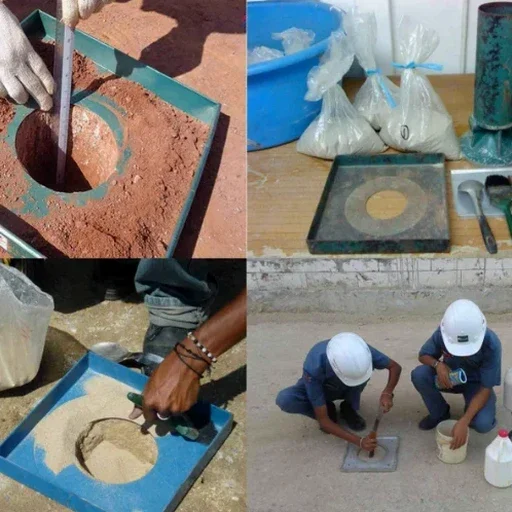
The Canadian Shield bedrock under North Bay sits at variable depth: in some downtown blocks you hit granite at three meters, while near the escarpment it can plunge below fifteen. This means a single excavation might require rock socketing on the north wall and toe embedment in stiff clay on the south. Groundwater adds another layer: perched water tables trapped in sandy interbeds are common, and dewatering without understanding the fractured rock connectivity can pull water from unexpected zones. We model these conditions using finite element analysis calibrated with in-situ-permeability data from local boreholes. Every design must also account for frost penetration exceeding two meters in a typical North Bay winter, which shifts active earth pressures seasonally. The city's adoption of NBCC 2015 structural requirements, referenced through Ontario Building Code amendments, sets clear performance criteria we routinely meet.
Deep Excavation Design in North Bay: Rock, Clay, and Groundwater Reality
Technical reference — North Bay Ontario

Site-specific factors

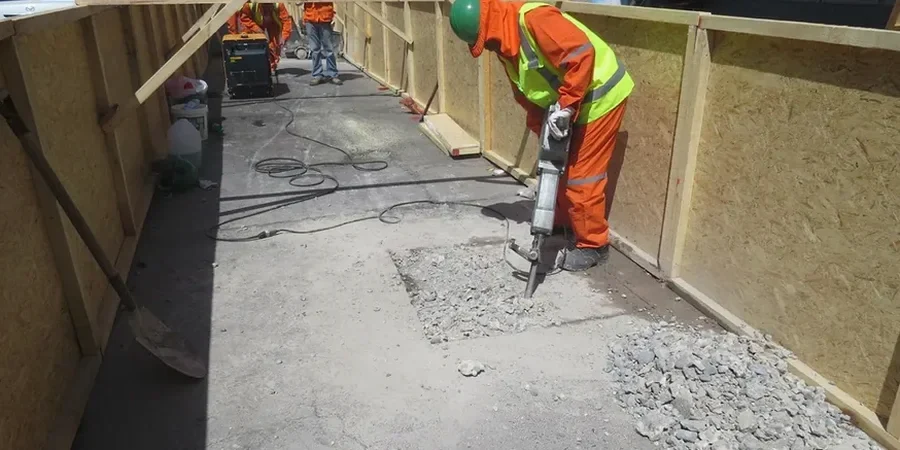
Ontario Regulation 332/12 and the NBCC structural provisions frame the legal duty on deep excavation safety, but in North Bay the practical risk is groundwater blow-in at the rock-overburden interface. We have reviewed projects where uncontrolled seepage eroded the clay seam, causing sudden loss of passive resistance and wall deflection beyond service limits. This failure mode is particularly acute where the bedrock surface is steeply dipping, concentrating flow paths. A second hazard is frost jacking of tieback anchors installed in weathered rock zones: the seasonal freeze-thaw cycle in the top three meters can de-bond grout if the annulus was not designed for thermal cycling. Our designs specify staged excavation and real-time excavation-monitoring when these conditions are present.

Need a geotechnical assessment?

Reply within 24h.

Email: info@geotechnicalengineering.xyz

Applicable standards

NBCC 2015 (National Building Code of Canada), adopted with Ontario amendments, CSA A23.3 - Design of concrete structures for shoring walls and capping beams, Canadian Foundation Engineering Manual (CFEM) 4th Edition, ASTM D4395 for rock anchor pull-out testing procedures

Reference parameters

ParameterTypical value
Maximum excavation depth analyzedUp to 25 m below grade
Shoring systems designedSoldier piles, secant piles, diaphragm walls, soil nailing
Rock mass classificationGSI and RMR per Hoek-Brown criteria
Groundwater modelingSteady-state and transient seepage (SEEP/W)
Frost depth design factor2.4 m minimum for shoring face
Seismic load caseNBCC 2015 Seismic Hazard for North Bay (Sa 0.2s)
Deflection monitoring thresholdTypically H/500 for stiff soils

Quick answers

How close to the property line can a deep excavation proceed without damaging the adjacent building?

It depends entirely on the soil stiffness and the shoring stiffness. In the stiff silty tills common in North Bay's Gateway district, we can sometimes work within 1.5 meters of an existing footing if the shoring is designed as a cantilever wall with sufficient embedment. In softer clay zones, underpinning or a tied-back wall with real-time inclinometer monitoring becomes necessary. We always run a settlement analysis using the adjacent structure's foundation depth as input.

What does a deep excavation design typically cost for a commercial project in North Bay?

For a commercial or institutional excavation in the 4 to 10 meter depth range, design fees generally run from CA$2.560 to CA$11.410 depending on the complexity of the shoring system, the number of monitoring phases, and whether rock anchoring is required. A straightforward soldier pile design in granular till falls on the lower end; a multi-level tied-back wall in mixed rock and soft clay conditions pushes toward the upper end of that range.

How do you handle winter conditions during a deep excavation in North Bay?

Winter construction requires several adaptations. We specify heated enclosures for hydraulic shoring equipment and mandate that exposed clay faces be insulated with rigid foam board to prevent frost penetration from altering the active pressure zone. Concrete for capping beams must be placed with cold-weather admixtures meeting CSA A23.1 requirements. Our monitoring plans also include weekly thermal correction checks on inclinometer casings.

Location and service area

We serve projects in North Bay Ontario and surrounding areas.

View larger map