GEOTECHNICALENGINEERING
NORTH BAY ONTARIO
HomeSlopes & WallsRetaining wall design

Retaining Wall Design in North Bay Ontario

Technical studies that support your project.

LEARN MORE

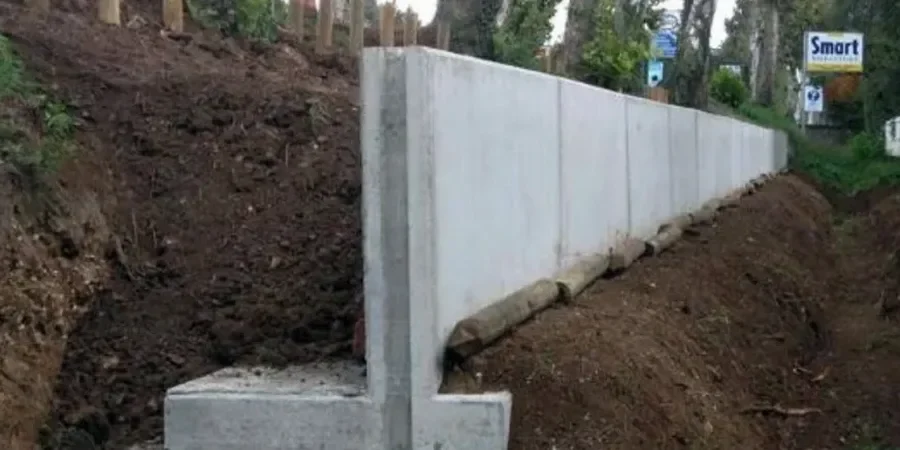
North Bay sits at 197 meters above sea level on the Canadian Shield, where Precambrian bedrock lies beneath a patchwork of glacial till and lacustrine clay deposited by ancient Lake Algonquin. In our experience, any retaining wall design in North Bay has to account for this abrupt transition between shallow rock and compressible silts — a condition that catches many out-of-town designers off guard. When a property on Airport Hill needs to hold back over 2 meters of saturated silty sand, standard cantilever assumptions fail fast. We combine field investigation with local geotechnical knowledge to produce designs that meet the 2020 National Building Code of Canada requirements, whether the wall supports a driveway off Lakeshore Drive or a commercial cut near Highway 11. A solid retaining wall design here starts with understanding what lies beneath the surface, which is why we frequently pair conceptual layouts with a test pit investigation to visually confirm stratigraphy before committing to reinforcement lengths.

In North Bay's glacial clays, a retaining wall without proper subdrainage is not a wall — it's a future leaning structure waiting for the first spring thaw.
Our service areas

Process and scope

The expansion of North Bay's residential neighborhoods into the escarpment zones during the 1970s and 80s created a legacy of gravity walls and timber crib structures, many of which are now reaching the end of their service life. What we see repeatedly in these older retaining wall designs is a lack of subdrainage and an underestimation of frost penetration, which in this region routinely exceeds 1.8 meters according to municipal frost depth requirements. A modern retaining wall design for North Bay demands a solid drainage system behind the wall — granular backfill wrapped in non-woven geotextile, a perforated toe drain with positive outlet, and weep holes at regular intervals. For walls exceeding 1.2 meters, we typically specify reinforced concrete cantilever or segmental block configurations with geogrid reinforcement, verified through internal stability analysis per CSA A23.3. The key differentiator is the frost protection detail: we extend the granular zone well below the frost line and insulate the backfill with extruded polystyrene where the wall abuts a heated structure. These are not textbook details; they come from watching too many walls tilt forward after their third North Bay winter.
Retaining Wall Design in North Bay Ontario
Technical reference — North Bay Ontario

Site-specific factors

The contrast between North Bay's humid continental summers and its deep-freeze winters creates a freeze-thaw cycle that punishes poorly drained retaining structures. We have documented cases where a 2.4-meter wall along Trout Lake Road experienced 60 mm of outward rotation over just two winters because the backfill trapped water that froze and expanded laterally against the stem. The secondary risk — and one that surprises many property owners — is the presence of sensitive clay lenses in the low-lying areas near Chippewa Creek and the La Vase River. These clays lose significant strength when remolded, meaning that a localized slip during excavation can propagate further than anticipated. Our retaining wall design protocol for these zones includes a minimum factor of safety of 1.5 against global stability failure, verified through limit equilibrium analysis using Spencer's method, with groundwater modeled at the worst-case spring level. Overlooking either frost jacking or sensitive clay behavior turns a straightforward retaining wall into a costly remediation project within a few seasons.

Need a geotechnical assessment?

Reply within 24h.

Email: info@geotechnicalengineering.xyz

Applicable standards

NBCC 2020 (National Building Code of Canada, Division B, Part 4), CSA A23.3-19 (Design of Concrete Structures), OPSS 206 (Ontario Provincial Standard Specification for Retaining Structures), ASTM D6913/D6913M (Particle Size Distribution for backfill materials)

Reference parameters

ParameterTypical value
Minimum frost penetration depth (North Bay)1.8 m (per municipal requirements)
Typical retained height range0.9 m to 6.5 m
Design standard for concrete wallsCSA A23.3-19
Seismic hazard factor (NBCC 2020)Sa(0.2) = 0.18 (Site Class C)
Backfill friction angle (granular)32°–38° (compacted, per project specs)
Common foundation soil typesGlacial till, silt, clay, shallow bedrock
Typical geogrid long-term design strengthLTDS ≥ 29 kN/m (varies by product)
Weep hole spacing for masonry wallsMaximum 1.5 m centers

Quick answers

What is the typical cost range for a retaining wall design in North Bay?

For a residential retaining wall design in North Bay, the engineering fee typically ranges from CA$1,350 for a straightforward segmental block wall under 1.5 meters to CA$5,360 for a complex reinforced concrete wall over 4 meters requiring global stability analysis and municipal review coordination. The scope includes the geotechnical recommendations, structural calculations, stamped drawings, and the Schedule C general review commitment when required. Every quote is project-specific because the site conditions — depth to bedrock, soil type, and groundwater — vary significantly across the city.

Do I need a building permit for a retaining wall in North Bay Ontario?

Under the Ontario Building Code, a building permit is generally required for retaining walls that exceed 1.0 meter in exposed height or that support a surcharge (such as a driveway or building). The City of North Bay's building department also requires a Schedule C engineer's commitment for walls over 1.2 meters or where the wall is part of a site plan application. Our design packages include all documentation needed to satisfy the permit review process.

How long does the design process take from investigation to stamped drawings?

For a typical residential retaining wall in North Bay, the timeline is approximately three to four weeks from the field investigation to the issuance of stamped drawings. The site visit and soil sampling take one day, laboratory testing of backfill and foundation soils requires about one week, and the engineering analysis and drafting take an additional two weeks. Municipal review timelines vary, but we work closely with the City of North Bay to address comments efficiently.

Location and service area

We serve projects in North Bay Ontario and surrounding areas.

View larger map