GEOTECHNICALENGINEERING
NORTH BAY ONTARIO
HomeGeophysicsElectrical resistivity / VES (Vertical Electrical Sounding)

Geophysical Resistivity Surveys (VES) in North Bay, Ontario

Technical studies that support your project.

LEARN MORE

North Bay sits right where the Canadian Shield meets the St. Lawrence Lowlands, but most of the city is draped in a thick blanket of glacial till and glaciolacustrine clays left behind by Lake Algonquin, the ancient predecessor of modern Lake Nipissing. That means you can go from exposed Precambrian granite on one lot to thirty meters of saturated silty clay on the next — and guessing wrong gets expensive. Electrical resistivity methods, particularly Vertical Electrical Sounding, cut through that guesswork by mapping how easily current flows through the subsurface. In our experience, a well-calibrated VES survey in North Bay can differentiate clean sand aquifers from the Champlain Sea-type clays, pinpoint the bedrock interface, and flag zones where road salt or former rail-yard activities may have altered pore-water chemistry. We often pair the results with a CPT test to directly measure tip resistance and pore pressure in the soft sediments, which gives a ground-truthed tie between the geophysical model and the actual soil behavior before anyone puts a shovel in the ground.

Resistivity in North Bay is less about finding water and more about mapping the clay-bedrock transition that governs excavation stability and foundation cost.
Our service areas

Process and scope

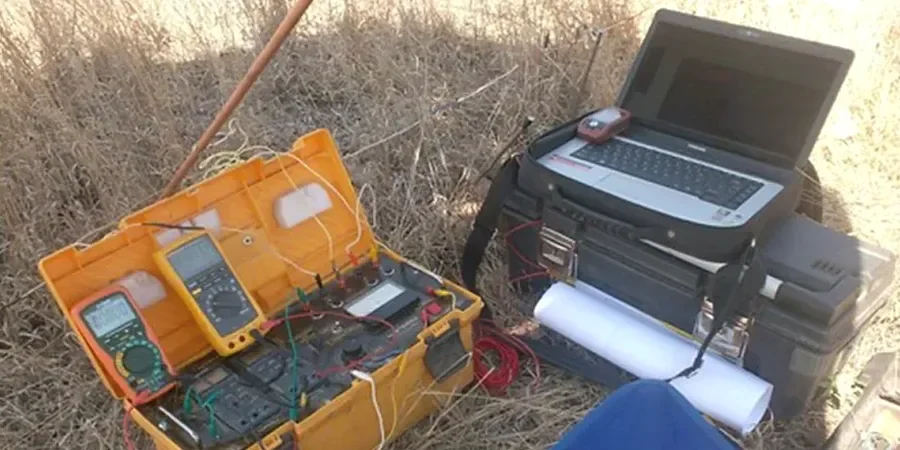
The freeze-thaw cycle here is relentless. North Bay sees over 200 centimetres of snow in an average winter and the ground can stay frozen well into April, which changes how we approach resistivity work. Frozen soil is essentially an insulator, so if you shoot a survey in February without accounting for the high-resistivity frozen crust, you will misinterpret it as bedrock or dry gravel. Our field team schedules VES campaigns for late spring through early fall whenever possible, and when winter work is unavoidable, we run temperature-compensated arrays and cross-check with borehole data. The survey layout is flexible: Schlumberger arrays for deep vertical profiling, Wenner arrays for lateral mapping of contaminant plumes or buried infrastructure. Because the Nipissing escarpment and the proximity to Trout Lake create localized groundwater flow patterns that can vary by the block, we also reference seismic refraction surveys where the bedrock is suspected to be shallow but highly fractured — the combined velocity and resistivity cross-section is far more reliable than either method alone.
Geophysical Resistivity Surveys (VES) in North Bay, Ontario
Technical reference — North Bay Ontario

Site-specific factors

A contractor was trenching for a new watermain along Cassells Street near the Chippewa Creek floodplain. The geotechnical report from the 1990s showed bedrock at roughly 4.5 metres, so the excavation plan assumed a short open-cut with standard shoring. When the hoe hit saturated silty clay at 3 metres and kept going to 7 metres without touching rock, the trench started slumping and they had to backfill and redesign the shoring on the fly. The delay alone cost more than a resistivity survey would have. What had happened was a buried bedrock valley — a pre-glacial channel later filled with soft lacustrine sediment — that the old boreholes had simply missed. A VES line across the alignment would have shown the low-resistivity signature of that clay-filled channel and flagged the anomaly before the tender went out. In North Bay, where the bedrock surface can undulate by metres within a single city block, skipping the geophysical step is a gamble that almost never pays off. For deeper excavations near the escarpment, we also recommend a slope stability analysis informed by the actual overburden geometry.

Need a geotechnical assessment?

Reply within 24h.

Email: info@geotechnicalengineering.xyz

Applicable standards

ASTM D6431-18 — Standard Guide for Using the DC Resistivity Method, NBCC 2020 — National Building Code of Canada (geotechnical inputs for seismic site class), CSA A23.3 — Design of Concrete Structures (foundation references), MTO OPSS 206 — Ontario Provincial Standard for Geophysical Surveys

Reference parameters

ParameterTypical value
Typical survey depth (Schlumberger)50 m to 120 m below grade
Array configurations usedSchlumberger, Wenner, dipole-dipole
Glacial soil resistivity range15 to 80 ohm-m (saturated clay to sandy till)
Canadian Shield bedrock resistivity200 to >1000 ohm-m (fractured to massive granite)
Typical profile length100 m to 400 m per spread line
Data inversion softwareRES2DINV / EarthImager 2D
Applicable standardASTM D6431 (surface geophysical methods)

Quick answers

What does a VES resistivity survey cost for a typical residential lot in North Bay?

For a standard Vertical Electrical Sounding survey on a single residential or small commercial lot, you are generally looking at a range of CA$980 to CA$1,260. The final number depends on how many sounding points are needed, the accessibility of the site along the spread line, and whether we need to bring in additional temperature correction data if the survey has to be run during late fall or early spring conditions.

Can resistivity surveys find water table depth in the glacial soils around Lake Nipissing?

Yes, and they do it well in the North Bay area because the contrast between dry silty sand and saturated sand is electrically very clear. The water table typically appears as a sharp drop in resistivity. That said, in the Champlain Sea-type clays that appear in some lower-elevation parts of the city, the clay itself is conductive whether saturated or not, so the water table signature gets masked. In those cases we usually recommend pairing resistivity with a CPT sounding to independently measure pore pressure and confirm the interpretation.

How long does a field resistivity survey take on site?

A single VES sounding with a Schlumberger array to 80 or 100 metres depth takes about 45 minutes to an hour once the cables are laid out. A full 2D imaging line of 200 to 300 metres, using a multi-electrode system, typically takes half a day including setup and breakdown. The bigger variable in North Bay is surface conditions: survey lines through heavy bush or across exposed granite outcrops take longer because we cannot always use the automated electrode planters and have to set each electrode manually with a portable hammer drill.

What depth can a VES survey reach in Canadian Shield terrain?

The depth of investigation is controlled by the maximum current electrode spacing, not by the rock itself. With a practical AB/2 spacing of 150 metres, we can routinely image to depths of 100 to 120 metres. In North Bay, that is usually more than enough to get through the overburden and well into the Precambrian basement. The limiting factor is often access: to stretch a 300-metre-long cable spread you need a clear corridor, which is not always available on smaller urban lots or steep escarpment slopes.

Location and service area

We serve projects in North Bay Ontario and surrounding areas.

View larger map